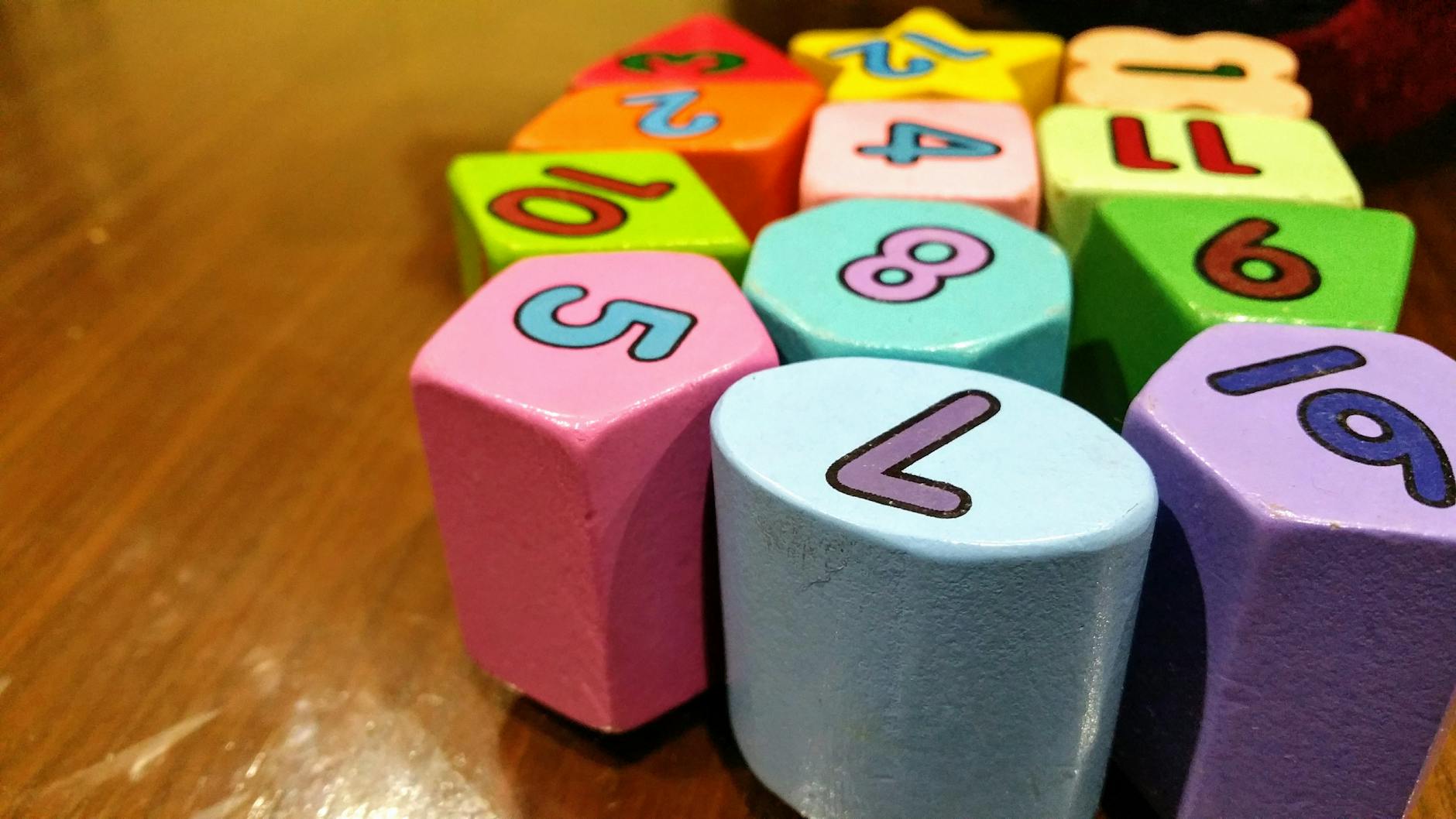
Math Games That Make Numbers Come Alive (Even for the Kid Who Hates Math)
My son cried at math worksheets for two years. Then we found games. Here are the ones that changed everything — no flashcards required.
A little note: Some links in this post are affiliate links. If you click through and buy something, we earn a small commission at no extra cost to you. We only ever link to things we would genuinely recommend to a friend.
My son used to cry at math.
Not dramatically, not for attention. Just quietly, with his chin down, staring at a worksheet like it had personally insulted him. We tried three different curricula in two years. We tried timers, incentive charts, math songs, and one very ill-advised attempt at making multiplication "fun" with stickers.
Then we started playing games.
I want to be very clear: I do not mean games as a reward after the real math. I mean games as the math. Real mathematical thinking, real number sense, real problem solving — wrapped in something that looks like play because it is play.
Here is what has worked for us.
Why Games Work When Worksheets Do Not
The explanation is simpler than it seems.
When a child does a math worksheet, the goal is visible: get the answers right. Errors are visible as errors. The child who is struggling knows they are struggling because the paper shows it. For a child who already feels anxious about math, the worksheet is a document of failure.
When a child plays a math game, the goal is to play well. Mathematical thinking is the mechanism, not the subject. The child who miscounts in Sleeping Queens and therefore cannot steal a queen has made a move that did not work, not an error that will be marked in red. They try again. The same mathematical operation, but the emotional valence is completely different.
Games also produce repetition without the tedium of repetition. A child who plays Zeus on the Loose for forty-five minutes has added two-digit numbers in their head dozens of times. They would not have tolerated forty-five minutes of addition practice. The repetition happened inside something they wanted to do.
For Building Number Sense (Ages 4-8)
A gentle board game where players move through a swamp by solving simple addition and subtraction problems on dice. It does not feel like drill. It feels like a swamp adventure. My daughter asked to play this before bed for months.
These colored rods have been used to teach math for over a hundred years. Children can see, feel, and physically build number relationships. We use them for addition, subtraction, fractions, multiplication, and just free play — free play teaches more than most people expect.
Players collect queens by playing number cards in arithmetic combinations. My six-year-old started doing mental multiplication just to collect more queens faster. Nobody asked her to. She figured it out because she wanted to win.
For Multiplication and Division (Ages 7-11)
This is the game that fixed my son's relationship with math. Players race to the center of a spiral board using addition, subtraction, multiplication, and division. The board is color-coded by prime factors so patterns become visually obvious. After two months of Prime Climb, he could tell me which numbers were prime without thinking. He still does not know that was the goal.
A deck of cards that plays like 20 different games depending on the age and level of your child. The same deck grows with them. We have used it for counting, subitizing, addition, and multiplication over several years — exceptional value and genuinely beautiful design.
Players add cards to a running total and try to hit certain numbers to steal Zeus. Fast, funny, loud, and deeply mathematical. Mental addition gets very quick very fast when there is a tiny Zeus figurine at stake. This one comes to dinner, road trips, and waiting rooms.
For Spatial Reasoning and Geometry (Ages 9 and up)
Spatial reasoning. Geometric thinking. Strategy. Blokus builds all three while looking like a colorful puzzle game. It is genuinely one of the best geometry supplements that has ever crossed our table and it requires zero setup and zero tears.
If you want to go deeper into three-dimensional geometry, Zometool is extraordinary. Children build polyhedra, explore symmetry, and construct models of structures from architecture and nature. My son built a dodecahedron on a rainy afternoon and spent the next hour looking up what the word meant.
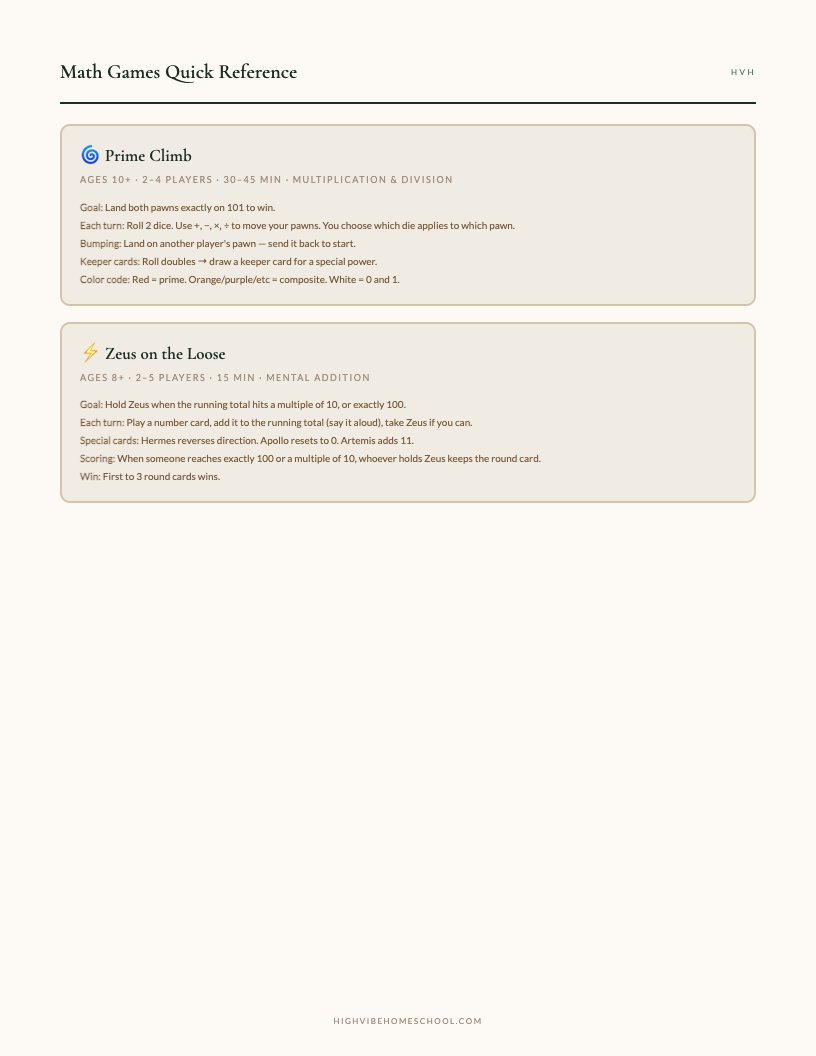
Free Download
Math Games Instruction Cards
Print-and-play instruction and scoring cards for 5 math games: Prime Climb, Zeus on the Loose, Sleeping Queens, Sum Swamp, and Tiny Polka Dot.
No spam. Unsubscribe anytime.
Card and Dice Games That Cost Nothing
Not every family can buy a box game every month, and several of the most effective math games require nothing but a standard deck of cards.
War with a twist. Standard card game War, except each round, both players flip two cards and multiply them together. Highest product wins both sets of cards. Speed matters, which means mental multiplication gets faster fast.
Thirty-one. Each player is dealt three cards and draws and discards in turn, trying to get three cards of the same suit that add to thirty-one or as close as possible. Requires ongoing mental addition and a sense of probability. Works for ages eight and up.
Dice race. Two dice, a target number (say, 100). Players take turns rolling both dice and choosing to add, subtract, multiply, or divide the two numbers showing, adding the result to their running total. First to reach 100 exactly wins. The choice of operation on each roll makes this strategically interesting, not just arithmetic drill.
A standard deck of cards plus a few six-sided dice gives you hundreds of hours of legitimate math practice, for free.
How to Use Games Alongside Your Curriculum
Games are not a replacement for a math curriculum. They are a supplement to one. The curriculum provides the sequence and the concept introduction. Games provide the practice that makes the concepts fluent.
In practical terms: if your child is currently working on multiplication in their math program, look for games that involve multiplication. Play them for fifteen or twenty minutes on days when the formal math lesson felt hard. Play them on Fridays when the week is winding down. Play them on sick days when no one wants to open a book.
The child who plays Prime Climb twice a week while also working through their math curriculum will internalize multiplication facts faster than a child who only uses the curriculum, because the game provides a different kind of engagement with the same operations.
There will also be a point, probably around the upper elementary years, when games alone are genuinely insufficient. Abstract algebra, the logic of proofs, the structure of statistics — these eventually need more direct instruction than games provide. The foundation of number sense and arithmetic fluency that games build is what makes that higher-level instruction successful.
One Thing About Screen Math
There are some decent math apps and we use them occasionally for drill. But the games above create something that screens cannot quite replicate: a shared experience. When my son finally understood prime numbers through Prime Climb, there was someone else at the table to notice.
That moment is the whole point. The math is almost secondary.
Almost.
If you are trying to figure out which math curriculum to use alongside the games, our honest comparison of homeschool math curricula walks through what we tried and why we switched. And if the tears around math are less about curriculum and more about the learning environment, deschooling might be worth reading first.
Written by
The High Vibe Homeschool Team
We are a homeschool family that has been doing this for seven years across three kids. We write about what we have actually tried, what failed, what surprised us, and what we would do again. No credentials. Just lived experience.
ENJOYED THIS ARTICLE?
Get more like it every week
Real homeschool life, in your inbox.
Keep Reading
More in Curriculum
 Curriculum
Living Books: What They Are and How to Find Them
Charlotte Mason's term for books that feel alive. Here's what makes a book 'living,' why it matters, and a list of the ones that have done the most for our homeschool.
 Curriculum
Teaching Writing at Home (When You Don't Feel Like a Writing Teacher)
Writing is the subject most homeschool parents fear most. Here's how we finally made it work — and the approach that produces the most growth for the least friction.
 Curriculum
Classical Education: What It Actually Is and Whether It's Right for Your Family
Classical education is having a revival. Here's an honest explanation of the trivium, who it works for, who it does not, and what the best resources look like.