
What to Do When Everything Goes Wrong (A Survival Guide for Bad Homeschool Days)
The days when your kid refuses to do anything, you lose your patience, and you question every decision you have ever made. Here is what to actually do when a homeschool day goes off the rails.
There is a version of homeschooling that exists on social media where every morning starts with a child eagerly settling in at a tidy desk, a cup of tea steaming on the table, sunlight streaming through the window, and everyone happy to learn.
And then there is my Tuesday last week.
My younger one woke up crying about something she could not explain and spent forty minutes on the floor of her room refusing to get dressed. My older one got into a fight with me about a math assignment before 9am. I said something I am not proud of. She cried. I felt terrible. We ate cereal for lunch because I had not thought ahead. We did about forty-five minutes of school the entire day.
That day happened. And it was a bad one. But here is what I have learned after years of doing this: bad days are not evidence that you are failing. They are just part of the territory.
First: Stop Trying to Force It
I wasted a lot of energy in my early years trying to power through bad days. Refusing to give up. Insisting we were going to finish the lesson even if it took two hours and everyone was miserable.
Here is the honest truth: nothing sticks when a child is in an emotional state that is not conducive to learning. You can sit them in front of the math worksheet all you want. They are not learning math. They are learning to associate math with feeling terrible.
When a day is going badly, the most productive thing you can do is often to stop. To declare it a different kind of day. Not a failure. A pivot.
What a "Different Kind of Day" Can Look Like
Some of the best reset options I have found:
Read aloud. Just read together. Something good, something you both like. This requires nothing of your child except to listen, and the connection of being together with a story can shift the mood of an entire morning.
Go outside. I do not care if it is cold or cloudy. Get everyone outside and move around for at least twenty minutes. Something about air and movement genuinely changes the emotional temperature of the day. We call these "walk it off" days.
Watch a documentary. Put on something educational and interesting and do not feel guilty about it. A good documentary is a legitimate learning experience. We have had some of our best conversations after unexpected documentaries on topics we stumbled into.
Do something physical and creative. Build something. Draw. Cook together. These days tend to be remembered as good days by my kids even though they were sparked by a crisis.
Formally declare a day off. Sometimes the answer is just to stop and say, "today is not a school day. We are going to do something else." Then do something you all actually enjoy. The world will not end. The work will be there tomorrow.
How to Actually Call It and Move On
The part that trips people up is giving themselves permission to actually stop. They declare a pivot day and then spend the rest of the morning feeling guilty about it, half-trying to sneak school back in, and communicating their own anxiety to their kids.
If you are going to call a pivot day, call it cleanly. Say out loud: "We are done with school for today. This afternoon we are going to ____." Put the books away. Physically close the lesson. Then do the other thing with actual presence.
This is not lowering your standards. This is recognizing that a bad school day pushed through to the bitter end does more damage than a graceful stop. Your child's relationship to learning is more important than any single day's coverage.
The Difference Between a Bad Day and a Pattern
One bad day is nothing. It happens to every homeschool family, every week, at some frequency.
Five bad days in a row is something worth noticing.
When bad days cluster, they are usually pointing to something specific: a curriculum that is not working, a schedule that has no breathing room, a child who is not sleeping well, a season of unusual stress in the household, or the early signs of burnout.
The pattern matters more than any individual bad day. If you are mostly having good days with occasional bad ones, you are fine. If you are mostly having bad days with occasional good ones, look at the system, not the days.
Keep a simple tally if you are not sure which is which. One mark for a good day, one mark for a bad one. After two weeks, the picture is usually clear.
For the Moments When You Lose It
I am going to say something that homeschool communities do not talk about enough: we lose our patience with our kids. A lot. Probably more than parents who are not with their kids six hours a day.
This is not a character flaw. It is a math problem. You are spending an enormous amount of time with your children, you are their parent AND their teacher, and some days the pressure of that is real.
When you say something you regret or you raise your voice or you handle something badly, here is what to do: stop. Take a breath. And then repair.
Tell your kid you are sorry. Be specific about what you did. Tell them it was not their fault. Tell them you love them.
That repair is not a sign of weakness. It is one of the most important things you can model for your children. People who love each other and live closely together get frustrated and hurt each other sometimes. And they repair. That is what a healthy relationship looks like.
What to Do the Morning After a Bad Day
Some families want to address the bad day explicitly. Others do better just starting fresh without mention of it. You know your children.
What almost always helps: a lighter start. Begin the next morning with something pleasant and low-stakes. Read-aloud before anything else. A fun math game instead of a worksheet. Whatever your child's version of an easy win looks like.
The goal is to rebuild the association between school and something good before you re-introduce the work that caused friction. One easy morning is not going to set back your year. One morning that starts the conflict right back up where it left off the day before might.
Keeping the Long View
One bad day is not going to derail your homeschool. Ten bad days in a row is a signal worth paying attention to, but one or two difficult days a week is just real life with children.
When I am in the middle of a terrible morning, I try to zoom out. I think about the long view: the books we have read together, the conversations we have had, the things my kids have learned and made and figured out. One hard day does not erase any of that.
I also keep a running note on my phone of things that go well, specific moments I want to remember. On the bad days, I read back through it. It helps.
Free Download
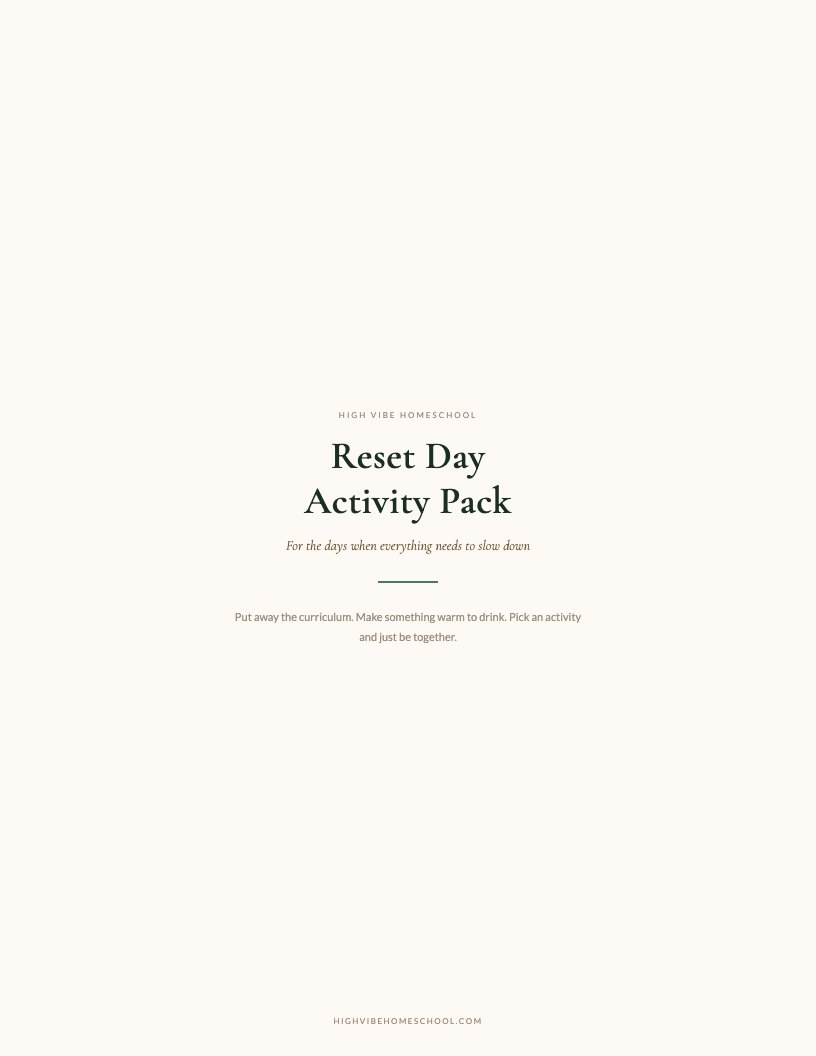
Reset Day Activity Pack
6 low-pressure activity pages for the hard days: coloring, a scavenger hunt, a writing prompt, a simple drawing game, and more.
No spam. Unsubscribe anytime.
You Are Still Doing This
The fact that a bad day bothers you this much is actually evidence of how much you care. Parents who do not care about their children's education do not lie awake questioning themselves.
You are going to have more bad days. So am I. And tomorrow, or maybe the day after, it will be a good one. Hold on for that.
If the bad days are coming in clusters rather than individually, homeschool burnout and burnout recovery go deeper on what to do when the whole season feels wrong. The reset day activity pack also has practical tools for the days when nothing planned is working.
Written by
The High Vibe Homeschool Team
We are a homeschool family that has been doing this for seven years across three kids. We write about what we have actually tried, what failed, what surprised us, and what we would do again. No credentials. Just lived experience.
ENJOYED THIS ARTICLE?
Get more like it every week
Real homeschool life, in your inbox.
Keep Reading
More in Daily Life
 Daily Life
How to End the Homeschool Year Well
The end of the homeschool year deserves more than quietly stopping. Here is how we close out the year intentionally — what we review, what we celebrate, and how we rest well before the next one begins.
 Daily Life
Homeschool Summer: How to Rest Without Losing Everything You Built
Summer in a homeschool is not the same as summer vacation. Here is how we structure ours — enough rest to restore everyone, enough continuity to make September feel like a continuation rather than a restart.
 Daily Life
Outdoor Science: The Homeschool Advantage You're Not Using
Most science curricula are indoor, textbook-based affairs. The outdoor world offers something they cannot: real science, happening in real time, available every day.